為可持續發展
提升人口潛能
Population Potential for
a Sustainable Future
Enhancing
Council for Sustainable DevelopmentInvitation and Response Document for the Second Engagement Process (June 2006)
可持續發展委員會第二輪社會參與過程誠邀回應文件(2006年6月)
為可持續發展
提升人口潛能
Population Potential for
a Sustainable Future
Content
5
7
9
11
19
25
I 29
II 31
Foreword
35Executive Summary
37Introduction
41Chapter 1
Hong Kong Population Trends and Overseas
43Perspectives
Chapter 2
What are the Options for a Sustainable Population
51Policy for Hong Kong ?
Chapter 3
Inviting Responses from the Community
59Annex I The Engagement Process of the Council for 63 Sustainable Development
Annex II Terms of Reference and Membership of the Council for 65 Sustainable Development, Strategy Sub-committee,
2004 2005
• • • • •
• • •
• • •
•
•
(1)
•
•
•
(2)
•
•
•
• •
(3)
• •
•
• • • •
1.1
1961
2005
2033
21961
2005
65+
0-14
1961 3 168 100 100 100 3.2% 1 283 900 40.5% 1971 4 045 300 182 300 4.5% 1 452 100 35.9% 1981 5 183 400 344 300 6.6% 1 277 300 24.6% 1991 5 752 000 502 400 8.7% 1 198 700 20.8% 2001 6 724 900 753 600 11.2% 1 104 100 16.4% 2005 6 935 900 836 400 12.1% 1 005 400 14.5%
2033
2013 7 386 900 978 000 13.2% 899 600 12.2% 2023 7 970 200 1 548 500 19.4% 922 600 11.6% 2033 8 384 100 2 243 100 26.8% 895 300 10.7%
1.1
3 85+ 80-84 75-79 70-74 65-69 60-64 55-59 50-54 45-49 40-44 35-39 30-34 25-29 20-24 15-19 10-14 5-9 0-4400 300 200 100 0 100 200 300 400 85+ 80-84 75-79 70-74 65-69 60-64 55-59 50-54 45-49 40-44 35-39 30-34 25-29 20-24 15-19 10-14 5-9 0-4
400 300 200 100 0 100 200 300 400 85+ 80-84 75-79 70-74 65-69 60-64 55-59 50-54 45-49 40-44 35-39 30-34 25-29 20-24 15-19 10-14 5-9 0-4
400 300 200 100 0 100 200 300 400
1961
2005
2033
2005 694 0.7%
2033 838 1 1% 2%
1 2004-2033 2004 6
12
1.2
1983
2005
2033
81983 1993 1999 2001 2003 2005 2013 2023 2033
1 000
1 722 1 342 982 932 901 966 993 993 993
1 800 1 460 1 340 1 330 1 290 – 1 340 1 380 1 390
(1)
1 800 2 020 2 010 2 030 2 040 – 2 140 2 200 2 210 – 1 760 1 690 1 630 1 710 – 1 730 1 740 1 740
(1) 1999 2100
(a)
2.
2005979 1000 2033 749 4
1980 24 2005 28
27 315
6
3
2005 1 0.966 2.1
7
3.
2005 57 09819 232 34% 10 395
8 837
9
4 2004-2033 2004 6
5 2005
6 1 000 15 49
7 YIP, P.S.F. and LEE, J. (2002). The impact of the changing marital structure on the fertility rate of Hong Kong SAR. Social Science and Medicine, 55, 2159-2169.
(b)
4.
10
2005
11
78.8 84.4
10 LAW, C.K. and YIP, P.S.F. (2002). Healthy Adjusted Life Years of Hong Kong SAR. International Journal of Public Health, 81, 1-7.
11
/ 12
1.3
1983 2005
2033
121983 1993 1999 2001 2003 2005 2013 2023 2033
72.3 75.3 77.7 78.4 78.5 78.8# 80.3 81.6 82.5
74.2 76.3 77.1 78.1 78.4 – 78.9 79.6 80.2
(1)
71.0 72.2 73.9 74.4 74.8 – 76.2 77.6 79.1 (2015) (2025) (2035) 71.3 73.7 75.0 75.7 76.3 – 79.0 80.5 81.7
78.4 80.9 83.2 84.6 84.3 84.4# 86.0 87.1 88.0
79.8 82.5 84.0 84.9 85.3 – 86.3 87.3 88.2
(1)
78.1 78.8 79.4 79.8 80.1 – 82.2 83.6 84.8 (2015) (2015) (2015) 77.3 79.0 79.9 80.4 80.7 – 82.7 84.2 85.3
: (1) 1999 2100
#
(c)
6.
2005 36 100 55 10020 400 39 500 13
2006
14
(d)
7.
1.6 161.2 17
1.4
1991 2005
141991 26 782 1998 56 039
1992 28 366 1999 54 625
1993 32 909 2000 57 530
1994 38 218 2001 53 655
1995 45 986 2002 45 234
1996 61 179 2003 53 507
1997 50 287 2004 38 072
2005 55 106
1.5
2005
150 – 14 7 493 7 045 14 538
15 – 24 2 573 2 591 5 164
25 – 49 5 075 28 084 33 159
50 – 64 542 1 232 1 774
65 140 331 471
15 823 39 283 55 106
13 14 15
16 1 000 15 64 15 65
17 400 1997 2019
18
19 400 1997 2019 2 5
1.6
182001 227 155 382
2003 216 161 378
2005 197 164 361
2013 163 178 341
2023 168 282 449
2033 171 428 598
(e)
8.
1973 2033
16
9.
10.
20
1993 (%) 2005 (%)
< 29 5.9 9.6
30 – 39 12.4 9.9
40 – 49 62.5 44.0
50 – 59 9.2 18.0
60 10.1 18.4
100.0 100.0
1.7
1993
2005
2011.
12.
74.5%
16 64
21 Richard Wong and Ka-fu Wong, HKU. The importance of migration flow to Hong Kong's future, November 2005
13.
60 65 65 67
14.
21
?
2.
3.
4.
(A)
5.
6.
2006-07
15.0% 17.3%
7.
8.
2005 60 64
65 69
30.2% 11.9%
(2)
2004 10 12 22
214 900 15
15 9.6%
2006
71.1% 52.1%23
20
2.1
1993
2005
241993 (%) 2005 (%) 1993 (%) 2005 (%)
/ 13.2 7.9 21.9 13.3
30.7 23.0 29.3 24.3 18.5 19.0 13.7 15.5 23.5 25.3 23.3 24.9
3.2 4.1 3.0 4.2
4.6 6.8 4.9 6.3
6.3 13.9 3.8 11.4
100.0 100.0 100.0 100.0
22
2005 8 23
(3)
25
2.2
252006 3 2004 2005 6 2006 (3) 2006
15-19 15.9 43.8(1) 14.4 (4) 11.6
20-24 68.6 70.5 73.6 70.7
25-29 74.5 73.1 86.6
76.1 86.2
30-34 61.8 74.0 78.6 79.3
35-39 62.8 74.5 69.9 71.6
40-44 71.1 76.7 66.1 79.1 66.6
45-49 72.1 78.2 63.6 61.7
50-54 70.1 74.5 54.0
70.1 52.1
55-59 59.0 65.0 38.0 36.4
60-64 38.5 45.4 19.6
11.3 14.7
65 12.2 11.1 (2) 1.6
47.6 59.2 56.6 56.6 52.1
(1) 16 19
(2) 65 69 70 74 75 9.7 4.2 1.2
(3)
(B)
9.
10.
11.
12.
13.
(1)
(2)
(C)
15.
16.
(1)
(2)
(3)
2.
3.
4.
1.
2.
3.
5.
6.
7.
8.
9. 26
10.
11.
26
5.
–
www.susdev.org.hk
–
http : //www.censtatd.gov.hk/hong_kong_statistics/statistics_by_subject/index.jsp
–
www.immd.gov.hk
–
http : //www.oecd.org/topic/0,2686,en_2649_34819_1_1_1_1_37419,00.html
–
www.childpolicyintl.org
–
http : //www.familyassist.gov.au/
–
http : //www.oecd.org/topic/0,2686,en_2649_37435_1_1_1_1_37435,00.html
–
http : //www.who.dk/document/hea/eactagepolframe.pdf
–
I
2.
1992Mrs G. H. Brundtland1987
3.
2003 34.
111 400 22 000
1 900
2005 5
5.
I.
II.
III.
IV.
V.
6.
II
a.
b.
c.
d.
G.B.S. J.P.
J.P.
J.P.
B.B.S.
J.P.
J.P.
J.P.
S.B.S. S.C. J.P.
B.B.S.
a.
b.
c.
B.B.S.
J.P.
B.B.S.
J.P.
J.P*
*
*
*
*
*
*
B.B.S. J.P.*
*
a.
b.
c.
d.
e.
B.B.S. J.P.
J.P.
Foreword
Hong Kong is internationally known for its vibrant activities in trade, finance, business and communications. In order to maintain this vibrancy, we must ensure that our city’s continued development is both viable and sustainable. While the efforts of preceding generations have helped create the standard of living we now enjoy, we, as custodians, must think about what kind of city that subsequent generations will inherit.
Sustainable development has become an accepted approach worldwide in tackling the challenges we face in pursuit of development and progress. The principles entrenched within this concept aim to seek common ground among competing social, economic and environmental values. They help us focus on what is important when considering our future and how to address the balance between competing needs.
The Council for Sustainable Development has made a mark in Hong Kong’s pursuit of sustainable development by spearheading an engagement process that solicits the diverse opinions of various stakeholders. Their views will subsequently have an impact on policy decisions regarding sustainable development. The first stakeholder engagement process took place during 2004 and 2005, where three pilot areas were discussed: solid waste management, renewable energy and urban living space. The process not only helped us navigate a way forward on long-term sustainable development strategies, but also provided an opportunity for the community to actively participate. It has created an awareness that changes have to be made in our lifestyles in order to meet the challenges ahead. It has also enabled the community to understand that, in finding the best solutions for Hong Kong, we must work together.
The stakeholder engagement process has been providing a unique opportunity to engage Hong Kong people in a dialogue about our future. As with the Invitation and Response document issued in 2004, the current one also presents important information that will establish the foundation for upcoming discussions. The document does not represent the stances and positions of the Government or the Council. Rather, it reflects issues raised by a group of stakeholders, with a view to engaging the wider community in further deliberation.
It is our fervent hope that the community will put forward its thoughts and views on the wide ranging issues set out in this document, as the results will affect both our future livelihood as well as our quality of life. We face many challenges ahead; and how we choose to navigate this complex course is a responsibility that matters not only to the current generation, but to all the generations to come. There are a series of events that follow the launch of this Invitation and Response document. I urge you to participate in as many as possible. Our way forward must be based on consensus and leadership from all sectors of the community.
Otto Poon
Executive Summary
HONG KONG POPULATION TRENDS AND OVERSEAS PERSPECTIVES
The Hong Kong population has grown steadily during the past decades, mainly due to rapid economic growth. It is about to undergo changes in the years ahead as a result of –
•Declining fertility rate
•Ageing of the population
•Longer life expectancy
•Population movements
•Changing dependency ratio
Without a farsighted and coherent population policy, Hong Kong may face the following possible situations –
•The size of the labour force will shrink, with a composition and structure that may not support the changing economic environment.
•The growing proportion of elderly people will have fewer productive workers to support them.
•The productive lifespan of the labour force may be lengthened but if we do not find effective ways to take advantage of this, valuable human capital may be lost.
•Qualified job seekers from the Mainland and abroad as well as local talent may decide to accept employment opportunities elsewhere.
•The overall physical and mental health of the labour force might be compromised as a result of job pressures while overall quality of life suffers.
•The current dynamism and vibrancy of Hong Kong may decline.
Other major cities around the world are struggling with problems similar to Hong Kong. Some have begun to introduce policies and measures to address relevant problems. These include –
•Providing financial incentives, family-friendly workplace arrangements and childcare assistance etc. to promote parenthood and induce the female population to enter (or re-enter) the workforce after having children.
•Gradually raising the retirement age to ease pressure on pension funds, keep older people productive and engaged, and take advantage of the energy and experience of the elderly who are living longer and healthier lives.
•Adopting immigration policies that encourage the free flow of talent within and between countries.
•Adopting measures which help working population better balance work and family commitments as well as social and personal pursuits.
WHAT ARE THE OPTIONS FOR A SUSTAINABLE POPULATION POLICY
FOR HONG KONG?
Options for the future may be considered from the three sustainability perspectives, including economic development, social harmony and protection of the natural environment. Possible options identified for further discussion are set out below.
(1) Economic Perspective
•Enhancing the capacity of the current and potential members of the workforce by providing appropriate education and training as well as advocating the extension of the population’s working life or gradually raising the retirement age.
•Unleashing hidden human capital by making it easier for mothers to stay in or re-enter the workforce, and encouraging older people to remain in the workforce if they so choose.
•Attracting talent from the Mainland and abroad and retaining local talent by offering competitive development opportunities, as well as attractive social and living environments.
(2) Social Perspective
•Supporting working women so that they can achieve a better balance between career development, family commitments, parenthood aspirations, and personal goals.
•Addressing the social needs of the elderly as well as the disabled and chronically ill, and finding creative ways to ensure that their energy and experience are properly channeled to the benefit of our society.
•Improving the quality of life of our population by encouraging healthier lifestyles, and promoting a better balance between work, family and leisure.
•Advocating the notion of a flexible life horizon to promote individual choices on life patterns.
•Promoting the value and benefit of cultural diversity and ethnic inclusiveness, and addressing the social and family needs of the immigrants and minorities so that they feel welcomed and accepted.
(3) Environmental Perspective
•Conserving and preserving natural resources to promote long-term sustainability for all.
•Creating an attractive living environment with better urban planning and buildings, accessible essential services, and a broad range of cultural and recreational facilities to attract incomers and retain local people.
•Ensuring accessibility for all by providing facilities, buildings and living spaces that cater for a wide range of accessibility needs including the elderly, physically challenged as well as able-bodied.
INVITING RESPONSES FROM THE COMMUNITY
A list of questions is included in Chapter 3 of this document to guide discussion and the submission of views from the community. The questions are divided into four categories –
•Quality of Life
•Family and Social Needs
•Ageing and Retirement
Introduction
Population Policy covers a wide array of issues, all of which have a direct bearing on our lives. It is not only about numbers and statistics. It has a clear and long-term impact on the structure and composition of our society, which in turn determine our economic competitiveness, the cultural and social vibrancy of our community, as well as the quality of life of our people. Rightly so, there is general concern over a falling fertility rate and the greying of the population. However, we can turn this threat into opportunities for careful reflection and creative solutions.
On Population Policy, you might wish to express your views on the means to promote parenthood, admit talent, or enhance security upon retirement. Also, we would like to invite you to take a step further and consider how population policy might affect our economy, society and environment. To move towards sustainable development, we are mindful that informed and sometimes difficult choices have to be made in order to balance economic development, social harmony, and protection of our natural environment. In line with this philosophy, we have attempted to analyse the current situation and possible options that address these three parameters. We hope to lead community stakeholders to discuss the issues and explore the way forward. There are no simple answers or solutions. Sometimes the solutions for the three sustainability pillars might even be in conflict. What we are faced with are questions of balance and what Hong Kong people feel is right for Hong Kong, for now and the future. All of the issues before us are complex and multi-faceted. We must rely on your participation and wisdom to guide us through.
This document aims to provide you with some basic information on –
•Population trends in Hong Kong as well as relevant overseas perspectives;
•How the population trends are affecting Hong Kong from the economic, social and environmental perspectives; and
•Potential options that we can consider to address the current situation and the envisaged demographic trends.
We have also identified some questions that may help guide stakeholders to think through and offer views on these important issues. These questions are set out in Chapter 3 of this document.
We look forward to receiving your views. Your comments and choices made on the issues presented in this document will make a real difference to the future of our city.
Wong Siu-lun
Chapter 1
Hong Kong Population Trends and
Overseas Perspectives
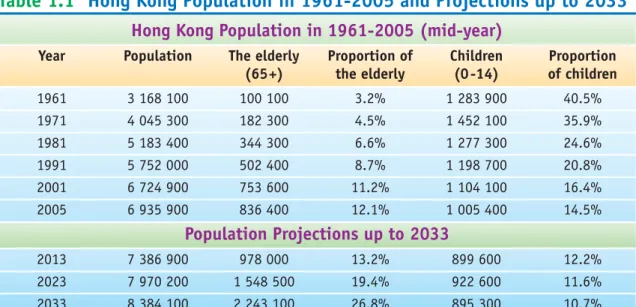
In the past few decades, Hong Kong has undergone significant economic development. Our industries have changed from a low-value-added and labour-intensive production mode to a high-value-added and service-oriented one. During this time, Hong Kong’s population has also undergone significant expansion. However, this growth trend is now slowing down. The population in mid-2005 was approximately 6.94 million. This is projected to increase only at an average annual rate of 0.7% to 8.38 million in 20331, much slower than the 1% to 2% experienced in the 1980s and 1990s. It is also important to note that a continuous ageing trend accompanies this declining growth. These are the results of a combination of factors, including low fertility rate and extended life expectancy.
1 HKSARG Census and Statistics Department, Hong Kong Population Projections 2004 – 2033, June 2004 2 HKSARG Census and Statistics Department
3 HKSARG Census and Statistics Department
Figure 1.1
Population Pyramid in Hong Kong
385+ 80-84 75-79 70-74 65-69 60-64 55-59 50-54 45-49 40-44 35-39 30-34 25-29 20-24 15-19 10-14 5-9 0-4
400 300 200 100 0 100 200 300 400 85+ 80-84 75-79 70-74 65-69 60-64 55-59 50-54 45-49 40-44 35-39 30-34 25-29 20-24 15-19 10-14 5-9 0-4
400 300 200 100 0 100 200 300 400 85+ 80-84 75-79 70-74 65-69 60-64 55-59 50-54 45-49 40-44 35-39 30-34 25-29 20-24 15-19 10-14 5-9 0-4
400 300 200 100 0 100 200 300 400
Thousand Persons Thousand Persons Thousand Persons
Age Age Age
Group
1961
Group2005
Group2033
Male Female Male Female Male Female
Table 1.1
Hong Kong Population in 1961-2005 and Projections up to 2033
2Hong Kong Population in 1961-2005 (mid-year)
Year Population The elderly Proportion of Children Proportion
(65+) the elderly (0 -14) of children
1961 3 168 100 100 100 3.2% 1 283 900 40.5%
1971 4 045 300 182 300 4.5% 1 452 100 35.9%
1981 5 183 400 344 300 6.6% 1 277 300 24.6%
1991 5 752 000 502 400 8.7% 1 198 700 20.8%
2001 6 724 900 753 600 11.2% 1 104 100 16.4%
2005 6 935 900 836 400 12.1% 1 005 400 14.5%
Population Projections up to 2033
2013 7 386 900 978 000 13.2% 899 600 12.2%
2023 7 970 200 1 548 500 19.4% 922 600 11.6%
(a) Fertility
2.
There is a projected gender imbalance in our population. The overall sex ratio in Hong Kong is expected to change from 979 males per 1000 females in 2005 to 749 in 20334. Besides, there is a growing tendency towards men and women marrying late or never marrying. The median marrying age for females at first marriage has increased from 24 in 1980 to 28 in 2005, and that for males has increased from 27 in 1980 to 31 in 20055. This phenomenon concomitantly translates into delayed childbearing, a drop in the marital fertility rate, and a significant decline in the total fertility rate6 in Hong Kong. The total fertility rate has fallen from 3 children per woman in the 1970s to less than 1 (i.e. 0.966) in 2005, which is far below the requisite replacement level of 2.1 per woman. This decline is not expected to be reversed in the near future, thereby making the ageing phenomenon more serious than anticipated7.44
Table 1.2
Comparison with Selected Economies on Total Fertility Rate in
1983-2005 and Projections up to 2033
8Actual
Projected
Economy 1983 1993 1999 2001 2003 2005 2013 2023 2033
(Number of live births per 1 000 women)
H.K. 1 722 1 342 982 932 901 966 993 993 993
Japan 1 800 1 460 1 340 1 330 1 290 – 1 340 1 380 1 390
U.S.A.(1)
1 800 2 020 2 010 2 030 2 040 – 2 140 2 200 2 210
U.K. – 1 760 1 690 1 630 1 710 – 1 730 1 740 1 740
Notes: (1) Projected figures are extracted from the middle fertility assumption (among three scenarios) of the population projection series 1999–2100.
3.
Furthermore, the proportion of Hong Kong live births born to Mainland mothers is on the increase. In 2005, there were a total of 57 098 live births, out of which 19 232 (around 34%) were born to Mainland mothers. These included 10 395 babies whose fathers were Hong Kong residents and 8 837 whose parents were both Chinese nationals but not Hong Kong residents9. This means that the number of Hong Kong live births does not necessarily translate into actual replenishment of the local population.
4 Figures excluded foreign domestic helpers. HKSARG Census and Statistics Department, Hong Kong Population Projections 2004 – 2033, June 2004
5 Provisional figures for 2005. HKSARG Census and Statistics Department
6 “Total fertility rate” refers to the average number of children that would be born alive to 1 000 women during their lifetime if they were to pass through their childbearing ages 15-49 experiencing the age specific fertility rates prevailing in a given year. 7 YIP, P.S.F. and LEE, J. (2002). The impact of the changing marital structure on the fertility rate of Hong Kong SAR. Social
(b) Life Expectancy
4.
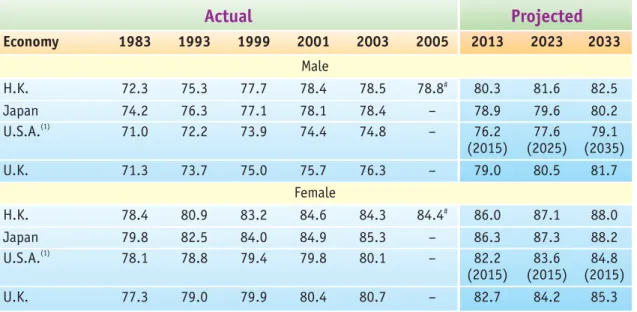
At the opposite end of the spectrum, the life expectancy of Hong Kong people has increased, which is largely attributable to advancements in medical technology and improvements in living standards. Hong Kong is one of the places that enjoy a long life expectancy10. Our population’s expectation of life at birth11 was 78.8 years for men and 84.4 for women in 2005, which compared favourably with other developed economies.Table 1.3
Comparison with Selected Economies on Life Expectancy at
Birth in 1983-2005 and Projections up to 2033
12Actual
Projected
Economy 1983 1993 1999 2001 2003 2005 2013 2023 2033
Male
H.K. 72.3 75.3 77.7 78.4 78.5 78.8#
80.3 81.6 82.5
Japan 74.2 76.3 77.1 78.1 78.4 – 78.9 79.6 80.2
U.S.A.(1)
71.0 72.2 73.9 74.4 74.8 – 76.2 77.6 79.1
(2015) (2025) (2035)
U.K. 71.3 73.7 75.0 75.7 76.3 – 79.0 80.5 81.7
Female
H.K. 78.4 80.9 83.2 84.6 84.3 84.4#
86.0 87.1 88.0
Japan 79.8 82.5 84.0 84.9 85.3 – 86.3 87.3 88.2
U.S.A.(1)
78.1 78.8 79.4 79.8 80.1 – 82.2 83.6 84.8
(2015) (2015) (2015)
U.K. 77.3 79.0 79.9 80.4 80.7 – 82.7 84.2 85.3
Notes: (1) Projected figures are extracted from the middle fertility assumption (among three scenarios) of the population projection series 1999–2100. Figures in bracket refer to the years of the projected expectation of life at birth.
# Provisional figures
10 LAW, C.K. and YIP, P.S.F. (2002). Healthy Adjusted Life Years of Hong Kong SAR. International Journal of Public Health, 81, 1-7.
11 “Expectation of life at birth” refers to the number of years of life that a person born in a given year is expected to live if he/she were subject to the prevailing mortality conditions as reflected by the set of age-sex specific mortality rates for that year. 12 HKSARG Census and Statistics Department
(c) Movements
6.
In 2005, there was a net inflow of 36 100 to the Hong Kong population, comprising an inflow of 55 100 One-way Permit holders and 20 400 Hong Kong non-permanent residents, as well as a net outflow of 39 500 Hong Kong permanent residents13. Currently, qualified candidates possessing skills not readily available in Hong Kong and having secured local job offers at market-rate remuneration may apply to enter Hong Kong for employment. Under the Quality Migrant Admission Scheme to be implemented in 2006, qualified individuals may apply to come to Hong Kong for settlement without obtaining a prior local job offer. The net inflow of people at working age may partly help redress population ageing.46
Table 1.4
Statistics on Arrival of One-way Permit Holders in 1991 - 2005
14Year Number Year Number
1991 26 782 1998 56 039
1992 28 366 1999 54 625
1993 32 909 2000 57 530
1994 38 218 2001 53 655
1995 45 986 2002 45 234
1996 61 179 2003 53 507
1997 50 287 2004 38 072
2005 55 106
13 HKSARG Census and Statistics Department. The figures may not add up to the total owing to rounding. 14 HKSARG Census and Statistics Department
15 HKSARG Census and Statistics Department
16 Child and Elderly dependency ratios refer to the number of persons aged under 15 and those aged 65 and above respectively per 1 000 persons aged between 15 and 64. “Overall dependency ratio” refers to the sum of child and elderly dependency ratios.
Table 1.5
One-way Permit Holders by Age and Sex, 2005
15Age group Male Female Total
0-14 7 493 7 045 14 538
15-24 2 573 2 591 5 164
25-49 5 075 28 084 33 159
50-64 542 1 232 1 774
65 and over 140 331 471
Total 15 823 39 283 55 106
(d) Dependency
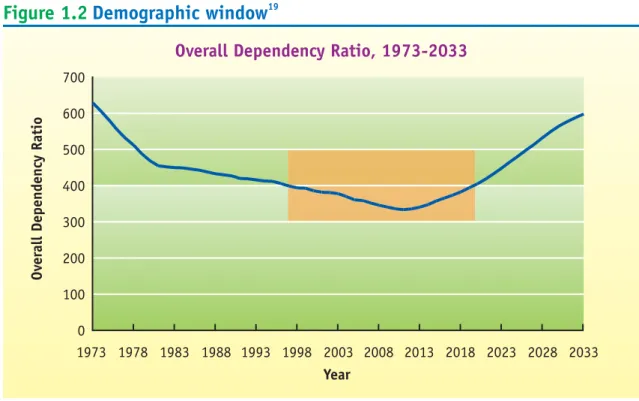
17 The demographic window is constructed by setting a cut-off for the overall dependency ratio. If the cut-off point is 400, we will then have a demographic window from 1997 to 2019, between which the overall dependency ratio is lower than 400.
18 HKSARG Census and Statistics Department
19 HKSARG Census and Statistics Department. The demographic window shown is the period (1997–2019) during which the overall dependency ratio is lower than 400, i.e. 2 dependents to 5 independents.
Table 1.6
Dependency ratios in Hong Kong
18Actual
Projected
Year Child Elderly Overall
2001 227 155 382
2003 216 161 378
2005 197 164 361
2013 163 178 341
2023 168 282 449
2033 171 428 598
Year
Overall Dependency Ratio, 1973-2033
Figure 1.2
Demographic window
19Ov
er
all Dependenc
y Ratio
concurrent rise in the elderly dependency ratio. Figure 1.2 points to a demographic window17, which opened up when the overall dependency declined because of the falling fertility rate experienced in the past several decades. However, this window will close in the years ahead as the overall dependency rises again with an increasing elderly population. The demographic window, with a lower overall dependency ratio and hence a smaller burden on the working population, provides an opportunity for the economy to grow and make preparations for the future before the overall dependency ratio starts to rise again.
(e) Quality issues
8.
Quantitative issues aside, the quality of our population and their quality of life are also central considerations in the formulation of a sustainable population policy. The former contributes significantly to the efficiency and productivity of our economy, while the latter should be the positive result of an improved economy.9.
The 1980s witnessed a trend of mass emigration of Hong Kong people. These were mainly people who were financially well-off, highly educated and skilled. When these people left Hong Kong, it gave rise to a “brain drain” problem. However, following reunification with the Mainland and stabilization under the “One Country, Two Systems” principle, many have returned to Hong Kong in recent years to explore new opportunities. This pool of returnees has contributed to the dynamism and vibrancy of the current labour force.10.
However, in a fast-paced economy such as Hong Kong, it is becoming more and more common that employment across many industries demand long working hours, resulting in significant psycho-social pressures on the working population. Over time, this may have a negative and possibly serious impact on the physical and mental health of the population. People are finding it more difficult to allocate time to accommodate other demands in their lives, such as social and family commitments. This translates into increased demand for substitute care for children and the elderly. There is an increasing albeit still small awareness of this problem among the population. More needs to be done to promote and safeguard their quality of life.48
20 Figures excluded foreign domestic helpers. HKSARG Census and Statistics Department
Table 1.7
Hong Kong Population by Hours of Work (per week),
1993 and 2005
20Hours of Work (per week) 1993 (%) 2005 (%)
<29 5.9 9.6
30-39 12.4 9.9
40-49 62.5 44.0
50-59 9.2 18.0
60 and over 10.1 18.4
Total 100.0 100.0
OVERSEAS PERSPECTIVES AND EXPERIENCE
11.
The challenges presented by an ageing population are not unique for Hong Kong. Other cities around the world and the Mainland see a similar need to address the trends of low fertility and increased life expectancy.12.
Many countries have introduced policies and initiatives to promote parenthood. These include financial incentives (such as tax incentives and allowances), family-friendly workplace arrangements and childcare assistance. For instance, the policy in Sweden aims at supporting women’s participation in the workforce and promoting gender equality, resulting in 74.5% of the female population aged 16 – 64 participating in the workforce and a total fertility rate of 1.7. Overall, developed economies around the world focus on providing an environment that supports the population’s childbearing and child rearing needs. There is yet no conclusive evidence on the effectiveness of these measures in promoting parenthood, but it is anticipated that they can at least help keep the fertility rate from dropping further.50
21 Richard Wong and Ka-fu Wong, HKU. The importance of migration flow to Hong Kong’s future, November 2005
14.
In addition, there is international competition for talent and professional skills among developed economies. Major cities such as London, New York and Tokyo have put in much effort to attract and retain qualified job seekers. These cities typically enjoy a free flow of talent from other parts of their countries. However, the inflow of Mainland talent into Hong Kong has been subject to regulatory control due to various compelling reasons such as concerns over the risk of opening a backdoor for Mainlanders to come to Hong Kong. Indeed, such control has been relaxed in recent years with the introduction of schemes such as the Admission Scheme for Mainland Talent and Professionals. Insofar as the inflow of talent from other countries is concerned, Hong Kong’s regulatory framework is comparable to those adopted by many developed economies. Economically vibrant cities in general exhibit stable age distributions in the population. This is mainly achieved through immigration of working age groups looking for development opportunities, as well as emigration of older people seeking quieter and less costly life styles21. This continuous ebb and flow of the population is key to maintaining the cities’ vibrancy. For instance, in major Mainland cities such as Beijing and Shanghai, municipal governments are proactive and flexible in offering preferential treatment to attract and retain overseas-trained Chinese students as well as other talent that support the pillar industries of individual cities.In considering options for a sustainable population policy to help Hong Kong maintain its vibrancy, we have to first consider whether there is an ideal or target population that best suits the unique circumstances and challenges facing Hong Kong.
2.
The proposition of an optimal quantitative population for Hong Kong may be untenable, as this may to a large extent hinge on new developments on various fronts such as technology. On the other hand, we can explore the qualitative dimensions of the issue, which include population composition. It is time we consider an appropriate population composition for Hong Kong that would help enhance the city’s competitiveness and attractiveness, as well as promote better quality of life for the population.3.
At the same time, we should be aware of the strong and vital inter-relationship between the population make-up and the economic structure of a city. We need to establish whether we wish the population composition to follow the economic structure or for the economic structure to be determined by the population composition.4.
The following sections set out the population policy’s sustainability considerations from three perspectives: economy, society and environment. The options explored below are not intended to be an exhaustive list of possible solutions, nor are they the Council for Sustainable Development’s preferred way forward. They are only some of the possible approaches, and are mentioned here to stimulate a meaningful and fruitful discussion.Chapter 2
What Are the Options for a Sustainable
Population Policy for Hong Kong?
(A) ECONOMIC PERSPECTIVE
5.
Hong Kong is a small city with limited natural resources. The most valuable and important “resource” of the city is its human capital. The creativity and productivity of the population are integral to its economic development and vibrancy.For instance, the health and social welfare portfolios are estimated to constitute 15.0% and 17.3% respectively of the recurrent Government expenditure in 2006-07. Further increases in their pies would imply less resources for other essential public services.
7.
To sustain the economic competitiveness of Hong Kong in the international arena, there are calls for strategic solutions to our shrinking labour force, and to the gap and mismatch between the new economic structure and the labour force. Solutions should also cater for the social needs of the population. In devising a long-term population policy that will have a bearing on our development for decades to come, we have to be visionary and allow sufficient flexibility to cope with the future changes in our society.8.
There are various approaches to expanding and prolonging the productivity of our labour force.(1) Enhancing the capacity of the labour force
Targeting current and potential members of the labour force, we can provide suitable education and training to enhance their capacity, so that they can meet the needs of the changing economy. For instance, the upgrading of our students’ biliteracy and trilingual proficiency, as well as the broadening of their international horizon will help improve the quality of our labour force.
Hong Kong has no mandatory retirement age per se. Individual employers or institutions may work out the appropriate retirement age for their staff members. The labour force participation rates for the elderly aged 60-64 and aged 65-69 were 30.2% and 11.9% respectively in 2005. In view of the increased life expectancy of the population and the improved productivity of older generations, we may consider advocating the extension of the population’s working life or gradually raising the retirement age.
In view of the higher education attainment among the female population, it is imperative to utilise this hidden potential for the benefit of our community’s development. Nonetheless, given the current employment structure in Hong Kong, a portion of the female population may find it difficult to participate in the labour force while accommodating their own personal goals and family needs. Employers and the business sector in particular should consider drawing reference from overseas, where there is more willingness to offer flexible and varied employment opportunities such as part-time jobs and job sharing, to cater for individual needs and thus maximize potential labour productivity. The availability of varied job opportunities may also encourage more elderly to stay in the labour force.
22 HKSARG Census and Statistics Department, Special Topics Report No. 41: Desire of economically inactive persons for taking up jobs if being offered suitable employment, August 2005
23 HKSARG Census and Statistics Department
24 Figures excluded foreign domestic helpers. HKSARG Census and Statistics Department
Table 2.1
Hong Kong Population by Education Attainment and Sex,
1993 and 2005
24Male Female
1993 (%) 2005 (%) 1993 (%) 2005 (%)
No school / Kindergarten 13.2 7.9 21.9 13.3
Primary 30.7 23.0 29.3 24.3
Lower secondary 18.5 19.0 13.7 15.5
Upper secondary 23.5 25.3 23.3 24.9
Matriculation 3.2 4.1 3.0 4.2
Tertiary : non-degree 4.6 6.8 4.9 6.3
Tertiary : degree 6.3 13.9 3.8 11.4
Total 100.0 100.0 100.0 100.0
Notes: Figures may not add up to the respective totals owing to rounding.
(2) Unleashing hidden human capital
We should not overlook the hidden human capital in our society which, if unleashed, can help expand our productive labour force.
According to a survey conducted by the Census and Statistics Department in October – December 200422, some 214 900 persons aged 15 and over were economically inactive at the time of enumeration but were willing to take up jobs if being offered suitable employment. They represented 9.6% of the total economically inactive population aged 15 and above at the time of enumeration.
54
(3) Attracting talent
Apart from enhancing local labour productivity, another complementary solution is the attraction of talent from elsewhere. The international economy is highly globalised and interlinked. The need for quality talent is shared by all developed economies, and Hong Kong is faced with immense competition from countries and cities worldwide. Hong Kong’s ability to attract talent from the Mainland and abroad as well as to retain local talent is dependent on the variety of development opportunities and the anticipated quality of life that our city is able to provide. Only population movements that include both healthy inflows and outflows of qualified job seekers will be beneficial to the economy.
The provision of more student exchange programmes at schools and universities, and the attraction of students from the Mainland and abroad will provide additional links to young people around the world. Hopefully, this will provide them with first-hand experience with living in Hong Kong and the type of development opportunities that are available. It is also important that we are able to induce Hong Kong people trained abroad to return and contribute to their home city.
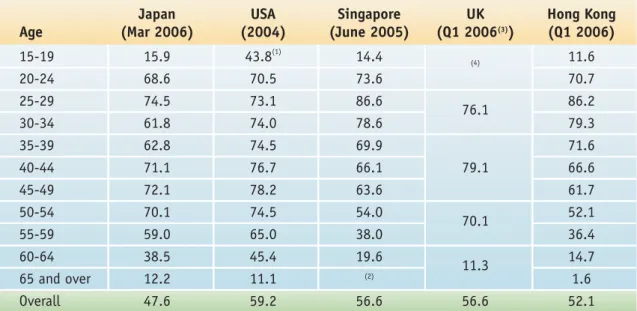
Table 2.2
Comparison with Selected Economies on Female Labour Force
Participation Rates (LFPRs)(%)
25Japan USA Singapore UK Hong Kong
Age (Mar 2006) (2004) (June 2005) (Q1 2006(3)) (Q1 2006)
15-19 15.9 43.8(1)
14.4 (4) 11.6
20-24 68.6 70.5 73.6 70.7
25-29 74.5 73.1 86.6
76.1 86.2
30-34 61.8 74.0 78.6 79.3
35-39 62.8 74.5 69.9 71.6
40-44 71.1 76.7 66.1 79.1 66.6
45-49 72.1 78.2 63.6 61.7
50-54 70.1 74.5 54.0
70.1 52.1
55-59 59.0 65.0 38.0 36.4
60-64 38.5 45.4 19.6
11.3 14.7
65 and over 12.2 11.1 (2) 1.6
Overall 47.6 59.2 56.6 56.6 52.1
Notes: (1) For those aged 16-19
(2) The LFPRs for those aged 65-69, 70-74 and 75& over were 9.7, 4.2 and 1.2 respectively. (3) Seasonally adjusted figures
(4) The LFPRs for those aged 16-17 and 18-24 were 48.7 and 69.8 respectively.
(B) SOCIAL PERSPECTIVE
9.
Our population is our city’s greatest asset. We must protect and enhance their social well-being to ensure dynamic and balanced development.10.
As mentioned above, it is imperative to unleash the hidden human potential among the female population. In fact, we have been witnessing a general increase in the female labour force participation rate. At the same time, the traditional expectation that women are responsible for the care of their families remains. As a result, women are often faced with making the difficult choice between career andfamily. Some of them may choose to leave the workforce after marriage or having children, while others opt for career instead of family and parenthood. Being “working mothers” is physically and mentally exhausting for most women as they are concurrently performing two highly demanding roles. Sometimes, the commitments and aspirations of these two roles may be in conflict, which is not conducive to better mental and physical health among the working female population. For the long-term
sustainability of our population, there is a pressing need to implement policies to help women attain a true equilibrium between their career development, family commitments and parenthood aspirations.
11.
In addition, it is important to address the social as well as financial needs of the elderly. Apart from their physical health which will have implications for the demand on public medical services, the promotion of psycho-social well-being is also an important component of healthy ageing. Having a purposeful life with continuous personal development, self-reliance, financial independence and harmonious relationships will all help to cultivate psycho-social well-being in older people.12.
At the same time, there is an increasingly prevalent number of singleton households in Hong Kong, including old people and young adults, who have minimal family network and hence significantly different social needs than the traditional family-oriented households. We should consider a framework which enhances the social well-being and meets the needs of this group of people.13.
In enhancing our population’s quality of life, we may consider promoting healthier lifestyles across all segments of society and providing a dynamic social environment that is attractive to talent from the Mainland and abroad as well as our own citizens.(1) Promoting healthier lifestyle
state of health for the elderly and the community will also help lengthen the population’s productive lifespan and reduce overall dependency on society, particularly with respect to medical and social services. Our social institutions should embrace and harness the experience and energy of the elderly for the benefit of both themselves and society. They may participate and contribute through various means, including but not limited to, freelance work, community service and volunteer work. Similarly, the needs of people with disabilities and chronic illnesses should also be addressed. We should not neglect or underestimate the positive contributions that this group of people can make.
Hong Kong is a dynamic and fast-paced economy. Long working hours and high job pressures are becoming more and more prevalent. The intense work pressure and lack of employment security in many cases may have been deterrents to childbearing decisions. We need to promote a culture of work-life balanceto encourage people to pay heed to other elements in their lives, such as family, leisure, as well as cultural and recreational pursuits. The Government and some quarters of the private sector are exploring or implementing the five-day week operation, to help reduce the pressure of the working population and improve the quality of their family life. Besides, flexible job opportunities such as home-office arrangements and freelance work can be promoted. This will not only enhance the social well-being of the population, but may also expand the overall productive labour force in the long run.
An incremental attitude change towards family, parenthood, the role of men and women in the family, as well as complementary initiatives such as more childcare facilities for working parents, may also help
stabilize the declining fertility rate in Hong Kong. Promoting the importance of family and the intangible benefits associated with parenthood may also help encourage decisions to bear children. However, we keep in mind the fact that personal choices regarding parenthood must be respected.
In view of increased life expectancy and with the aim of prolonging the population’s productive
lifespan, there have been suggestions that a flexible life horizon should be promoted. This concept means that societal and employment structures should allow people more flexibility and freedom to make individual lifestyle choices. For example, retirement age should be a personal decision rather than being bound by societal constraints. Similarly, the decision to temporarily leave the workforce to accommodate personal pursuits should not become an obstacle to re-entering the job market at a later stage.
(2) Providing an attractive social environment
Job seekers will take into account a city’s overall attractiveness in choosing the place where they work and live. When we consider a suitable immigration or talent admission policy/scheme to meet our own economic needs, we should also be mindful of the social needs of target groups. A socially-oriented immigration policy, which addresses needs such as the admission of family members or key employees, could be
advantageous in attracting qualified job seekers. For example, the provision of adequate international school places may be an important determining factor when talent from overseas decides whether to move to Hong Kong with his or her family. More family-friendly recreational activities and more diverse cultural programmes may also provide an enjoyable family life for the immigrants.
The population of Hong Kong is essentially ethnic Chinese. Expatriates and ethnic minorities make up a relatively small group. There is a need to build community consensus on and awareness of the advantages of cultural diversity and ethnic inclusiveness, as well as the benefits that immigrants and minorities bring to our economy. It is important that they feel welcomed and accepted by the local community.
(C) ENVIRONMENTAL PERSPECTIVE
14.
Hong Kong’s living environment is not only important to the quality of life of our own population, but also determines the attractiveness of our city to the talent from the Mainland and abroad. This also affects foreign investors’ decisions to invest in Hong Kong.15.
The natural resources supporting the world’s population are finite. The accumulation and formation of fossil fuels, for example, require a very long time. However, the world’s development on various fronts in the past decades has used up our natural resources at a very fast pace.(1) Preserving our limited resources
In the past, the pressures of a fast-growing population, often closely related to the need to accommodate rapid economic growth, has led to congestion and overcrowding. This has implications not only for the natural environment, but also for our long-term competitiveness, psycho-social well-being and public health.
The conservative use and preservation of our resources are necessary for the sustainable development of our city and to support its economic and social growth. The decline in our population growth may, from a positive perspective, offer an opportunity for careful reflection, with a view to reducing the mounting pressure on our natural environment and resources.
(2) Creating an attractive living environment
A living environment that attracts talent from the Mainland and abroad as well as retains local skills will have to meet the increasing aspirations for lower living density and improved living standards. It has to appeal to a mobile generation looking for opportunities around the world, and at the same time support the needs of an ageing population. The public concern about Hong Kong’s air quality will also have to be addressed properly.
Architecturally striking buildings are essential components in any attractive city landscape. These apart, good urban design providing natural air corridors and sunlight, revitalized neighbourhoods, green and innovative buildings, as well as interesting local heritage also contribute to an attractive living environment, and in turn higher overall quality of life and a healthier lifestyle.
The provision of municipal services to the population is also important. Hygiene conditions, law and order, social stability, and medical services at affordable costs are all imperative. The availability of cultural and recreational facilities and activities add an attractive dimension to city life.
(3) Building an accessible environment for all
Although the advancement of medical technology and the promotion of healthier lifestyles might help enhance the overall physical well-being of the elderly, it is envisaged that the number of elderly people requiring some type of mobility assistance will continue to rise. Hence, the planning and design of buildings and facilities should take into account the needs of the elderly in order to help them maintain independence and mobility.
We need an accessible environment for all. In future, buildings will hopefully be capable of catering for a wide range of accessibility needs, regardless of whether users are elderly, physically challenged or able-bodied.
This document outlines the key issues pertinent to a sustainable population policy for Hong Kong as well as some possible options.
2.
The Council for Sustainable Development would like to invite you to respond to this document, advising us on your views and choices on these issues and options. It is important that we have your views as these will have a long-term bearing on the sustainable development of our city not only for us but for our future generations as well.3.
Our analysis in Chapter 2 revolves around the three sustainability pillars of economic development, social harmony and environmental protection. However, the questions listed below are not organised under these three pillars. This is done to avoid confusion that may be caused by overlapping issues. For better organisation during ensuing discussions, the questions are grouped under four broad categories, namely Quality of Life, Family and Social Needs, Ageing and Retirement, as well as Nurturing, Attraction and Retention of Talent.4.
We welcome feedback on the issues and options presented in Chapter 2 and the questions below. We also look forward to receiving any further information, suggestions and questions that you might have relating to population policy. Your views will help shape the recommendations that the Council for Sustainable Development will give to the Government on the way forward for a sustainable population policy for Hong Kong.QUESTIONS
Quality of Life
1. How satisfied are you with the quality of life in Hong Kong? Why? Are there any particular aspect which you would like to address in order to improve your quality of life?
2. Some suggest that instead of putting emphasis on increasing the population, we should consider ways to enhance the quality of life of the population, amidst a slower population growth rate. What are your opinions on this?
Chapter 3
Family and Social Needs
3. What are the factors that would affect your decision on childbearing? What incentives do you consider effective in encouraging parenthood?
4. What do the notions of “family” and “parenthood” mean to you? Do you think there is a need to promote the importance of family and the intangible benefits associated with parenthood?
5. Do you consider a stronger emphasis on a family-friendly working environment and work-life balance culture would enhance or impair the economic competitiveness of Hong Kong? What is the role of the business and employer sector in this area? What specific initiatives would be helpful to promote such a culture?
6. How can our community better cater for the social needs of the increasing number of singleton households, including old people and young adults, who have minimal family network and hence significantly different social needs than the traditional family-oriented households?
Ageing and Retirement
7. How would you like to enjoy your elderly life? How would you like to continue to participate in and integrate with the society?
8. Do you think there is a need to advocate extending the working life of the population or raising the retirement age? What is the suitable age for retiring from work?
9. How would you perceive the notion of a “flexible life horizon”26?
60
Nurturing, Attraction and Retention of Talent
10. In considering options to meet society’s needs, should we put more emphasis on nurturing and training our own population as well as attracting overseas-trained Hong Kong students to return, or should we focus on attracting talent from the Mainland and abroad?
11. How can we promote Hong Kong as a hub for talent? More diverse education and development opportunities? A more attractive living environment? More cultural diversity and ethnic inclusiveness?
FURTHER INFORMATION
5.
We have tried to keep this document concise with the necessary information to facilitate an informed dialogue with you. If you would like to learn more about the related issues, you may wish to look at the following websites.- Sustainable Development Strategy website www.susdev.org.hk
- Census and Statistics Department: Hong Kong Statistics
www.censtatd.gov.hk/hong_kong_statistics/statistics_by_subject/index.jsp
- Immigration Department www.immd.gov.hk
- Organisation for Economic Co-operation and Development (OECD) information on Family-friendly Policies
www.oecd.org/topic/0,2686,en_2649_34819_1_1_1_1_37419,00.html
- International Child, Youth and Family Policies www.childpolicyintl.org
- Australian Government Family Assistance Office www.familyassist.gov.au
- OECD information on Ageing Society
www.oecd.org/topic/0,2686,en_2649_37435_1_1_1_1_37435,00.html
- World Health Organisation Active Ageing: A Policy Framework www.who.dk/document/hea/eactagepolframe.pdf
CHANNELS FOR RESPONSE
6.
In the coming months, the Council for Sustainable Development will work with the partner organisations from various sectors to implement a programme of events aimed at engaging people in the community to comment on the issues presented in this document. We will reach out to different stakeholders and citizens, hoping to gather opinions from a wide sector of the community.7.
In addition, we have an open and interactive channel of communication through the Sustainable Development Strategy website at www.susdev.org.hk. The website features the latest information on engagement events and an online discussion forum, where you are invited to exchange your views with other members of the public.8.
We welcome comments by post, fax and email, through the office of the Council Secretariat by 31 October 2006. Please send in your views to –Sustainable Development Unit M/F, Murray Building
Garden Road, Central Hong Kong
Fax: 3150 8168
E-mail: [email protected]
9.
Unless parties making submissions to us specify a reservation, we shall assume that they have licensed us to reproduce and publish their views in whole or in part in any form and to use, adapt or develop any proposals put forward without the need for permission from or subsequent acknowledgment of those parties.WHAT IS SUSTAINABLE DEVELOPMENT?
In order to move towards sustainable development, we need to make informed choices about how best to advance our economic and social development while protecting our natural environment.
2.
The international community increasingly emphasises the importance of sustainability. In 1992, the United Nations Agenda 21 called for countries, cities and other administrations to develop their own strategy or agenda for sustainable development. A sustainable development strategy usually comprises a vision or direction, together with targets and programmes in areas that are important to the long-term sustainability of a society.“Development that meets the needs of the present without compromising the ability of future generations to meet their own needs” – Mrs Gro Harlem Brundtland in her report “Our Common Future” to the United Nations, 1987.
COUNCIL FOR SUSTAINABLE DEVELOPMENT
3.
The Council for Sustainable Development was established in March 2003 to advise on, inter alia, the preparation of a sustainable development strategy for Hong Kong. During the initial term of the Council, it designed and implemented a five-stage engagement process to engage the community in a discussion on the sustainable way forward in the three pilot areas chosen for the exercise – solid waste management, renewable energy and urban living space.4.
In the first engagement process, the Council hosted four public forums, 11 regional public workshops, a Youth Forum and a Sustainable Development Strategy Summit. Total attendance at these events exceeded 1,400, and another 22,000 people were estimated to have visited the Council’s roving exhibition that toured various public locations. The Council received over 1,900 responses through the channels set up specifically to gather stakeholders’ views on the pilot areas. The Council was receptive to stakeholders’ comments, and put forward its recommendations to the Government. The first engagement process concluded with the issue of the Government’s First Sustainable Development Strategy for Hong Kong in May 2005. Thereafter, the Government and other stakeholders have been working on the plan of action, with a view to achieving sustainable objectives and targets set out in the Strategy.Annex I
The Engagement Process of
SECOND ENGAGEMENT PROCESS
5.
The Council for Sustainable Development is working on the second engagement process. The five stages of the process are as follows –I. Identifying Priority Areas
A public stakeholder forum was held in July 2005 to invite stakeholder views on the new priority areas. The Council considered the forum outcome and decided to take forward two priority areas – Better Air Quality and Population Policy.
A separate Study Group has been established to put together the information on the air quality issue, which will form an informed basis for the Council to decide on the engagement process on this priority area.
The current engagement will focus on the second priority area, that is, population policy.
II. Preparation of a document to invite responses
A stakeholder-led Support Group on Population Policy was set up to advise on the preparation of this Invitation and Response (IR) document. This document aims at providing the general public with the necessary information to support their informed discussion on the sustainable way forward on the issue.
III. Directly involving the wider community
The Support Group will arrange a series of forums, workshops and summits to engage the community in a dialogue on the sustainable options for our population policy. Partner organisations will assist in engaging a wide sector of stakeholders to gather their views. Other communication channels such as online discussion forum will also be available.
IV. Reporting
The Strategy Sub-committee of the Council, with the help of the Support Group, will assess the community response and present a report to the Council. The areas of consensus and where there are conflicting views will be highlighted. The Council will then advise the Government on the sustainable way forward for the population policy.
V. The Government to act
The Government will take into consideration the Council’s advice and publish a strategy document on the population policy, which will map out its strategic objectives, targets and plan of action with a view to achieving sustainable outcomes.
6.
The Council will continue to review and repeat the engagement process with other priority areas which are of concern to the general community.Terms of Reference
a. To advise the Government on the priority areas it should address in promoting sustainable development;
b. To advise on the preparation of a sustainable development strategy for Hong Kong that will integrate economic, social and environmental perspectives;
c. To facilitate community participation in the promotion of sustainable development in Hong Kong through various means, including the award of grants from the Sustainable Development Fund; and
d. To promote public awareness and understanding of the principles of sustainable development.
Membership
Chairman: Chief Secretary for Administration
Vice-chairman: Dr. Edgar Cheng, G.B.S., J.P.
Members: Dr. Lily Chiang
The Honourable Choy So-yuk, J.P.
Mr. Barrie Cook
Ms. Christine Fang, J.P.
Mr. Hans Michael Jebsen, B.B.S.
Mr. Thomas Kwok, J.P.
Mr. Michael Lai, J.P.
Professor Lam Kin-che, J.P.
The Honourable Andrew Liao, S.B.S., S.C., J.P.
Ir. Otto Poon, B.B.S.
Mr. Tai Hay-lap, B.B.S., J.P.
Professor Tsui Lap-chee
Secretary for Economic Development and Labour
Secretary for the Environment, Transport and Works
Secretary for Health, Welfare and Food
Secretary for Housing, Planning and Lands
Annex II
Terms of Reference
a. To assist the Council for Sustainable Development with the formulation of a Sustainable Development Strategy for Hong Kong;
b. To engage stakeholders and the community and implement a consultation programme as agreed by the Council for Sustainable Development with a view to ensuring that the Sustainable Development Strategy is inclusive and widely accepted by the community; and
c. To report regularly to the Council for Sustainable Development on progress with the formulation of the Sustainable Development Strategy.
Membership
Chairman: Ir. Otto Poon, B.B.S.
Members: Dr. Lily Chiang
The Honourable Choy So-yuk, J.P.
Mr. Hans Michael Jebsen, B.B.S.
Professor Lam Kin-che, J.P.
Dr. Chan Wai-kwan, J.P. *
Ms. Anne Copeland Chiu *
Mr. Chua Hoi-wai *
Mr. Albert Lai *
Mr. Chandran Nair *
Mr. Ali Tuet *
Ms. Luciana Wong *
Professor Wong Siu-lun, B.B.S., J.P.*
66